anteros_lmc: (Default)
Ahem. [livejournal.com profile] nodbear and I have a wee announcement. Despite the fact that we are really just a pair of disreputable fangirls, astonishingly, we have been commissioned to write a book about the young gentlemen of HMS Indefatigable. Following our presentation at the New Researchers in Maritime History conference earlier this year, we were approached by the academic publisher Boydell and Brewer who expressed an interest in publishing our researcher. We've spent the last six months drawing up a proposal, which has now been approved by an academic reviewer and accepted by the publisher's editorial committee. So this weekend I went down to [livejournal.com profile] nodbear's to sign the contract :)

The current title of the book is a bit of a mouthful:

Naval Careers in the Napoleonic Wars - Hornblower's Real-Life Shipmates
The Lives of the Young Gentlemen of Pellew's Indefatigable

As an academic publisher, Boydell and Brewer's main criteria for their titles is that their subject matter will be immediately obvious to librarians and indexers! Hence the catchy "Naval Careers in the Napoleonic Wars" bit ;) We originally made no mention of Hornblower in our proposal and were surprised and very, very chuffed, when the academic reviewer suggested including Hornblower in the title. It also gives us a legitimate excuse to try and get a picture of Horatio and Archie into the book! :D

We now have two years to complete our research and write the book, and it will probably take another 18 months before it's published. So if we meet all our deadlines, we should be in print by....summer 2016. So don't hold your breath :} Also because we're signed up to an academic publisher, they will produce a vanishingly small hardback print run with an astronomical cover price. There's no such thing as advances in academic publishing, the royalties are minuscule and we have to cover all image licensing and indexing costs ourselves. That aside, we're over the moon about this and still can't quite believe that we've managed to pass ourselves off as "proper" naval historians.

So, huge thanks to everyone here who has already been so encouraging and enthusiastic about our research, we would never have got this far without the support of all you wonderful AoS fans. Wish us luck, in fact, wish us Ned's own luck!
anteros_lmc: (Default)
Alan Garner

Alan Garner
I've spent most of the day on a train travelling to and from a work event down south. Long day, but it did give me time to finish reading Alan Garner's new novel Boneland. I'm not even going to attempt to explain what it's about, but you can read Ursula Le Guin's review in the Guardian here. The Guardian also hosted a fascinating question and answer session with Garner, who rarely gives interviews. I've always been in awe of Garner's pared down writing style, so I loved this explanation he gave of his approach to writing:

"Every word has to beg for its life. Adverbs and adjectives are born guilty until proved innocent. When something is "finished", I cut it back, and continue until what is said can be said in no fewer words. This leads to clarity and impact, and also to an extra dramatic effect when the rule is broken and the words appear to run riot. They don't. They're on a strong leash."

The rest of the Q&A can be read here.

Swanston

Sep. 2nd, 2012 09:50 pm
anteros_lmc: (Default)
Earlier this week I spent three days doing a book sprint with a some of my work colleagues. A book sprint is basically a short facilitated writing retreat that aims to produce a book from scratch in five intensive days. However we only had half that time and to add to the challenge one of our team was called away on jury service :} As it was, three of us managed to write a 20,000 word book in two and a half days, which is not bad going. It was an interesting experience, and the technique seemed to work well for collaborative technical publications, though I am curious as to whether it would be suitable for creative writing.

We stayed in some converted farm steadings at Swanston on the outskirts of Edinburgh, close by Swanston Village where Robert Louis Stevenson spent some of his youth. Years later on Samoa, shortly before his death, Stevenson wrote of his longing to see the hills around Swanston one last time.

The tropics vanish and meseems that I, from Halkerside, from topmost Allermuir or steep Caerketton, dreaming, gaze again.

It's a pretty spot right enough...


anteros_lmc: (Default)
Write Queer London is a festival facilitated by the Museum of London which brings together writers and poets to explore LGBT history in London through a programme of curator talks, gallery tours, poetry commissions, a writing competition and creative writing workshops. I've been a bit slow on the uptake with this event as it started in December and I only found out about it today. The festival runs until February and a few highlights you might be interested in include:

A Great Unrecorded History
Thursday 19th January 14.15 to 16.00, free.

Curator Richard Parkinson explores British Museum objects which tell the story of same-sex desire – from ancient Egypt and Babylon to modern times. Followed by a poetry writing workshop with John McCullough in association with the Poetry Society and Arts Council England.

Write Queer London at the National Maritime Museum
Thursday 2nd February, 13.00 - 16.30, free.

Poet and artist Nancy Campbell leads a writing workshop looking at aspects of the history of gay seafarers and pirates. Explore the galleries and new Sammy Ofer wing.

Pleasure Garden Ball
Tuesday 14th February, 6.45 - 9.45, £6(£5)

Enjoy a night of dancing, drinking and decadence as we recreate Georgian London’s quintessential pastime – the pleasure garden. Learn to dance with an 18th century girl band, watch risqué poetry and theatrical performances, discover dandy fashion, then design and wear your own alluring masquerade mask.

Includes the finale of the Write Queer London Festival - with readings from poets and prizewinners.

As per bloody usual I can't get to any of these events but if anyone does make it along I'd love to hear more!
anteros_lmc: (Default)
This is a rather long summary of the talk Dr Stuart Allen gave last weekend in Edinburgh on the influence of Admiral Thomas Cochrane on naval adventure fiction. I've been trying to upload pictures to go with this post all weekend but the pesky hackers have crippled LJs scrapbook again. I do wish they'd bugger off. Annywaaay....

Allen, the head curator of the National Museum of Scotland's current exhibition on Cochrane was introduced as "Senior Curator of Military History, with a life long weakness for naval history" :)


Dr Stuart Allen, and a fine collection of boarding weapons


Admiral Cochrane - The Real Master and Commander )

I'll try and post a summary of Cordingly's lecture on Cochrane later in the week.

Deal

Sep. 10th, 2011 09:52 pm
anteros_lmc: (Default)
Dear [livejournal.com profile] mylodon,

350 words of Red Devil pls.

Kthxbai
[livejournal.com profile] anteros_lmc
x

PS 50 words knocked off for awful fluffed first penalty.

PPS Hope your nerves have recovered from this morning's performance.
anteros_lmc: (Default)
I was having a quick look over my Hornblower Remix draft this morning while having coffee. Daughter, who was wanting a shot of the laptop to play princess games, was peering over my shoulder and wanted to know what I was reading. I told her it was a story about sailors and she asked me to read it to her. So I chose a couple of reasonably innocuous paragraphs and started reading. Two paragraphs in and daughter told me to stop because it was "boring" and it was an "old dusty story". I am crushed! Crushed I tell you! I only hope the person I'm remixing will be a bit more enthusiastic about my creative endeavours. *grumble grumble*
anteros_lmc: (Default)
I'm a day late with this but never mind. Allow me to pimp the Speak Its Name Advent Calendar. A whole host of writers, some of whom might be rather familiar, will be posting a blog entry every day between now and Christmas. I have also been reliably informed that there will be prizes. If you hop over there right now you'll find a post by the very lovely [livejournal.com profile] charliecochrane which is prize enough in itself :)

Small Boy

Nov. 8th, 2010 11:24 pm
anteros_lmc: (Default)
This week sees the centenary of the birth of the Scottish poet Norman MacCaig, 14th November 1910 to 23 January 1996. This poem is a perfect illustration of his lyric style; spare, vivid and evocative. And I don't think I need to explain the image this poem evokes for me.

~ Small Boy ~

He picked up a pebble
and threw it into the sea.

And another, and another.
He couldn't stop.

He wasn't trying to fill the sea.
He wasn't trying to empty the beach.

He was just throwing away,
nothing else but.

Like a kitten playing
he was practising for the future

when there'll be so many things
he'll want to throw away

if only his fingers will unclench
and let them go.

From Voice-Over, 1988.
anteros_lmc: (Default)
Several weeks ago, in a comment on her fic Following a Head Injury [livejournal.com profile] eglantine_br asked:

Did they used "fucking" as an all purpose word as we do, as in "I'm really fucked now?" Could it be that the ship would fuck you over -- or was it only literal back then?

I'm not a linguist and I'm not even a "proper" historian, but I am an archaeologist so I've done a little digging and although I haven't got a definitive answer to the fucking question I turned up some interesting bits and pieces. Well, interesting if you're a word nerd anyway!

Fuck it )

Cross posted to [livejournal.com profile] following_sea.
anteros_lmc: (Default)
xkcd putting things in perspective.

It took me a while to find LJ on this map. It's down there in the south west, a small island west of the Sea of the Opinion and north of the Bay of Drama, lying between the tiny outcrops of Dreamwidth and fanfiction.net. Personally I'd have put LJ closer to the Bay of Grammar Pedantry but we can agree to differ ;)

Fourteen?!

Jul. 5th, 2010 09:38 pm
anteros_lmc: (Default)
I've just counted and I make it fourteen new pieces of writing that have been posted in this fandom in the last five days. Fourteen?! Seven of these are birthday gifts for Lord Hornblower and seven appear to be spontaneous offerings. And we've had everything; bookverse, movieverse, sonnets, drabbles, horoscopes, poetry, dark and light LKUs, fluff, smut, angst, slash, crack, gen and the most beautifully moving first time fic I have ever read. There's even been a sighting of that rarest of rare characters in this fandom, bookverse Kennedy!

I've said it many times before, when I stumbled across Hornblower fandom, while I was in awe of all the amazing fic that had been written, I was also very sad to have missed the boat by several years at least. Looks like I was wrong. It seems I came aboard just in time! So thanks to everyone for all this amazing creativity and special thanks to those that carried on writing through the doldrums.

Sorry, this is a completely cheesy post but what the hell!
anteros_lmc: (Default)
There's an interesting article on the Guardian book blog by Meg Rostoff about writing fiction about real historical characters: Tackling real-life characters in fiction is fine – as long as you do it well. The article seems to have been sparked by objections raised by the Anne Frank Trust about a fictionalised account of her life by Sharon Dogar, Annexed. Rostoff namechecks a wide range of other fictionalised historical characters including Shakespeare's Henry VIII, Hilary Mantell's Thomas Cromwell and Alan Bennet's Queen Elizabeth II. Interestingly she also goes on to briefly discuss spin-offs of literary classics:

All of this doesn't even begin to consider the literary (as opposed to historical) parasites. The zillion spin-offs of Pride and Prejudice could easily be considered a stain on the memory of Austen's classic
However although Rostoff is clearly no fan of literary adaptations she does conclude:

although I might not like what Dogar writes, I would defend to the death her right to write it.
I'm not even going to attempt to summarise the comments but there are some interestingly contradictory opinions put forward. Fanfiction does get a mention but only briefly. Several of the commenters express very strong objections to authors attributing historical events to fictional characters:

I blogged earlier this year about the author who took real life events and 'allowed' children the honour of doing the brave deed (in WWII) in place of the courageous men and women who actually did it in actual real life. Some paying for it with their lives. I thought it stank then, and it still stinks, as far as I'm concerned.
Which of course made me wonder, is this any different to what authors like O'Brian and Forester did by taking inspiration, and in some cases actions, from real characters such as Cochrane and attributing them to fictional characters such as Hornblower and Aubrey? Do O'Brian and Forester stink? I don't think so.

Another commenter suggests that historical novelists should acknowledge what they borrowed and what they made up.

Personally I read fiction for pleasure and history for fact, although the two are by no means mutually exclusive! I also think one of the great joys of Age of Sail fandom is being able to read a body of historical and contemporary accounts, literary fiction and fanfiction all of which complement and enrich each other wonderfully.
anteros_lmc: (Default)
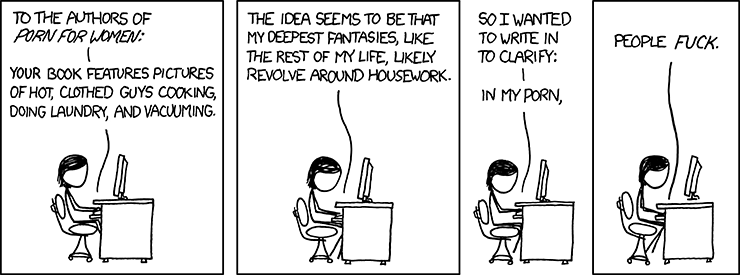
xkcd.com is pretty much required reading in my RL line of work but I thought this was worth sharing here. So very true. Particularly if you delete "people" and insert "cute naval officers" ;)

anteros_lmc: (Default)
I freely admit I know bugger all about writing. I tend to find it happens or it doesn't. I have no idea why, and I've never been greatly inclined to learn more about the process. I worked briefly as a web editor for a newspaper and it confirmed my suspicion that any job that involved writing on demand would be my idea of hell. And despite having spent most of my life working in higher education I have always managed to avoid posts that require you to publish or die.

Having said that I do enjoy writing, especially about pretty sailors or stuff other more talented folks have written. So although its not the kind of thing I would usually read I did rather like today's Grauniad article Ten rules for writing fiction which invited a bunch of authors to share their personal dos and don'ts. Here's a few of my favourites:

  • Using adverbs is a mortal sin.

  • Take something to write on. Paper is good. In a pinch, pieces of wood or your arm will do.

  • Don't go near the online bookies – unless it's research.

  • Do keep a thesaurus, but in the shed at the back of the garden or behind the fridge, somewhere that demands travel or effort. Chances are the words that come into your head will do fine, eg "horse", "ran", "said".

  • Don't write in public places.

  • The first 12 years are the worst.

  • Try to be accurate about stuff.

  • Don't have children.

  • It's doubtful that anyone with an internet connection at his workplace is writing good fiction.

  • Interesting verbs are seldom very interesting.

  • Write. No amount of self-inflicted misery, altered states, black pullovers or being publicly obnoxious will ever add up to your being a writer. Writers write. On you go.

  • Never use the word "then" as a conjunction – we have "and" for this purpose.

  • Don't drink and write at the same time.

  • Don't take any shit if you can possibly help it.

All advice I shall follow to the letter of course ;)

With thanks to Jonathan Franzen, AL Kennedy, Richard Ford, Anne Enright, Geoff Dyer, Roddy Doyle, Margaret Atwood andElmore Leonard.

Profile

anteros_lmc: (Default)
anteros_lmc

July 2016

S M T W T F S
     12
3456789
10111213141516
171819202122 23
242526272829 30
31      

Syndicate

RSS Atom

Most Popular Tags

Style Credit

Expand Cut Tags

No cut tags
Page generated May. 13th, 2026 02:24 am
Powered by Dreamwidth Studios